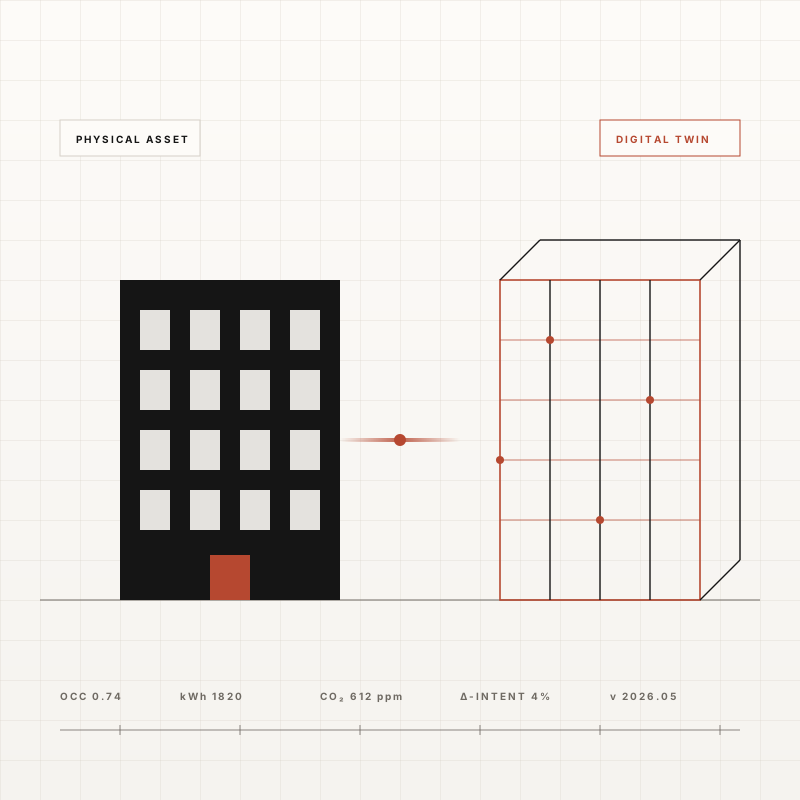
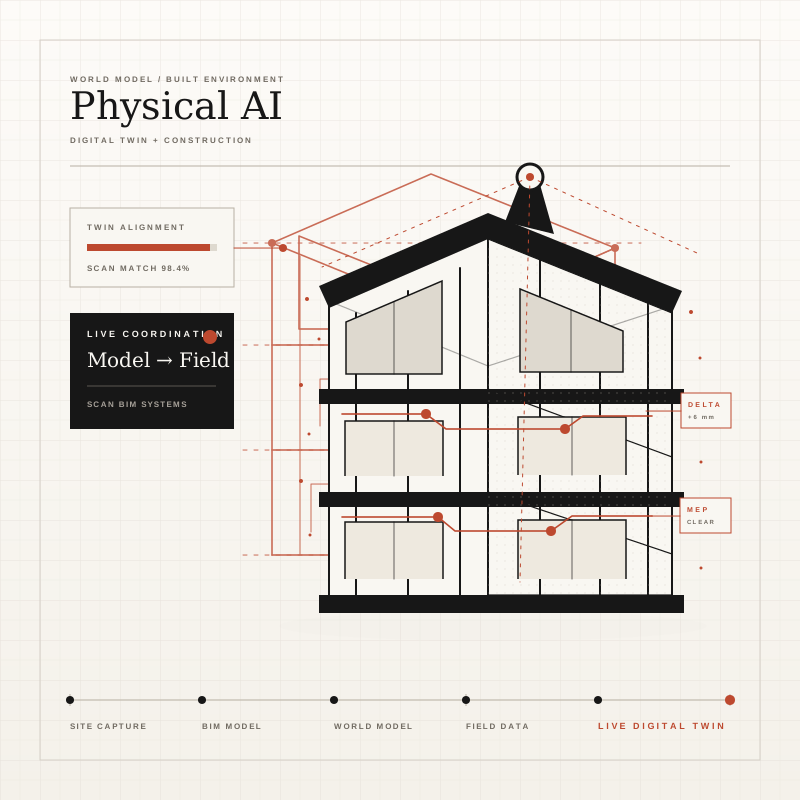
Sites & Space is actively evaluating how the Cosmos platform can shift our work from descriptive digital twins to predictive physical-AI workflows. The question is not whether simulation is useful. The question is whether a generative stack can help us make better design and fabrication decisions before expensive mistakes become physical reality.
The through-line in this exploration is practical: reduce cycle time, improve confidence, and create measurable value in the handoff between concept, documentation, and fabrication. We are studying Cosmos in combination with Omniverse and Isaac tooling because the stack appears capable of doing more than static visualization. It can generate scenarios, forecast likely states, and support decision-making under uncertainty.
From perception to foresight
Most production AI in the built environment still behaves like advanced perception. It can classify what is happening now: a defect, a clash, a drift from spec. Physical AI introduces a different posture: foresight. In this model, simulation and generative prediction are used together so teams can test multiple future outcomes and choose actions before failure conditions harden.
The real value is not prettier simulation. The value is earlier decisions with higher confidence.
Three opportunities we are evaluating
- Physics-aware prototyping for thermal and electro-mechanical risk reduction before tooling and formal testing.
- Predictive in-situ monitoring for metal additive and fabrication workflows, using multimodal process data to catch likely failures early.
- Digital simulation-to-real shop flow training for high-mix, low-volume fabrication where custom variability has historically blocked automation.
These tracks are intentionally different in maturity and commercialization path. The first can be launched as a service engagement. The second can evolve into a deployable monitoring product. The third has the largest long-term upside but requires the deepest integration effort across simulation, policy training, and shop-floor validation.
Why this matters for fabrication teams
Custom fabrication environments are defined by variation: changing geometries, changing tolerances, changing constraints. Traditional automation performs best in fixed, repetitive contexts. If Cosmos-assisted workflows can reduce the effort required to generate realistic training and test scenarios, the economics of automation in custom work could shift materially in favor of smaller, agile one-off shops.
Our near-term focus is disciplined experimentation with clear off-ramps: where prediction quality is strong enough to influence decisions, where it is not, and where a hybrid of human judgment and model assistance produces better outcomes than either alone.
Implementation stance
We are treating this as a phased program: build internal prototypes first, validate on constrained real-world cases second, and productize only where repeatability is proven. The strategic goal is to build specialized capability from general tools, grounded in real fabrication data and owner-side decision criteria.
As this work progresses, we will update this site. We are also open to collaboration with other design and fabrication teams who are interested in exploring Cosmos-assisted workflows. If you are a fabricator, engineer, or designer with a similar interest, please reach out to us.