A backyard greenhouse used to be a hobbyist object: a small glass box with tomatoes, a thermometer, and the occasional dead seedling. The next generation is something different. It is a closed-loop, sensor-mediated, software-defined growing environment that quietly produces a meaningful share of a household's food at a cost that is finally, narrowly, defensible.
For designers and engineers, this is one of the more interesting product categories of the decade. It sits at the intersection of climate, real estate, software, and agriculture, and it is being built mostly by small teams who refuse to be held by any one of those disciplines. The result is a design space that rewards generalists and punishes purists.
The forces lining up
Three forces are pushing the category from novelty to plausibility. First, supply chain fragility. The last five years made it visceral, even for households who had never thought about logistics, that the path from farm to plate is long and breakable. Second, energy costs and climate volatility. A controlled-environment grow space that runs on rooftop PV and a battery is starting to make economic sense in places where the calculus would have been laughable a decade ago. Third, the maturation of the underlying tooling. Sensors, controllers, and the software that orchestrates them are no longer artisan kit; they are off-the-shelf and they speak to each other.
None of those forces alone makes a market. Together they have produced a small but growing population of homeowners who want a system, not a hobby — something that runs in the background, integrates with the house, and produces food on a schedule.
The next greenhouse is software with a frame around it. The frame is the easy part.
What a serious system looks like
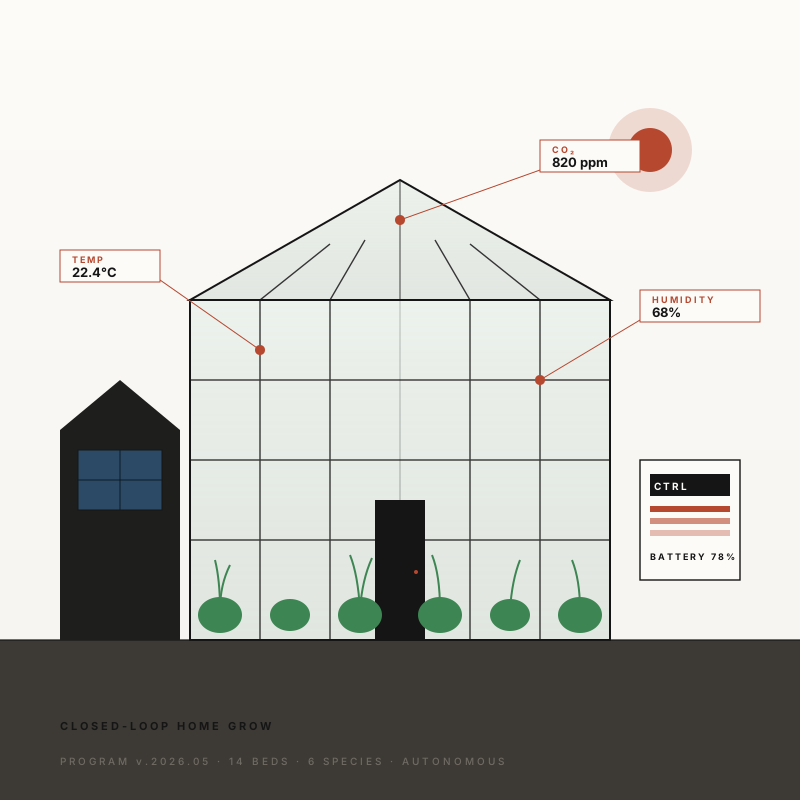
A modern backyard greenhouse is a small, well-instrumented building. Climate control is closed-loop: temperature, humidity, CO₂, and light are sensed at multiple points and adjusted by actuators that the homeowner never has to touch. Irrigation is scheduled and self-correcting, with leak detection that does not require an app to surface. The grow program is data-defined — a YAML file, effectively — that describes what is being grown, in which beds, on what schedule. Pest pressure is monitored visually and biologically, not chemically.
The interesting design choices are the boring ones. Where does the controller live; how is it powered when the house loses utility; what happens to the grow cycle when the homeowner is on vacation for two weeks; how does the system tell the homeowner something is wrong without crying wolf. None of these are exotic problems, but they are the difference between a system the household trusts and one that ends up unplugged in February.
Where the design opportunity is
For engineers, the most underrated layer is the operator interface. Most home-grow products today either drown the user in dashboards or hide everything behind a single "auto" button. Neither is right. The household needs a small number of clear levers — what is growing, when does it harvest, what is failing — and a set of safe defaults underneath. The interaction model is closer to a thermostat than to a farm management platform, and the products that figure that out first will define the category.
For architects and built-environment designers, the opportunity is to treat the greenhouse as a deliberate room of the house, not an outbuilding. Integrated greenhouses share thermal mass with the home, recapture humidity, and contribute to the home's overall energy performance in a way that a detached glass shed cannot. Designed in from the start, a 120-square-foot growing space adds less cost than most homeowners assume and produces more output than a standalone unit twice its size.
The forward-looking question is how this category interacts with neighborhood-scale infrastructure. A house that is a small food producer is also, in aggregate, a small participant in a local food network. The interesting product is not the single greenhouse; it is the protocol that lets dozens of them on the same block share a delivery route, a maintenance contract, or a surplus harvest. That is a software problem dressed up as a real estate problem, and it is exactly the kind of seam in which thoughtful design practice gets to do its best work.