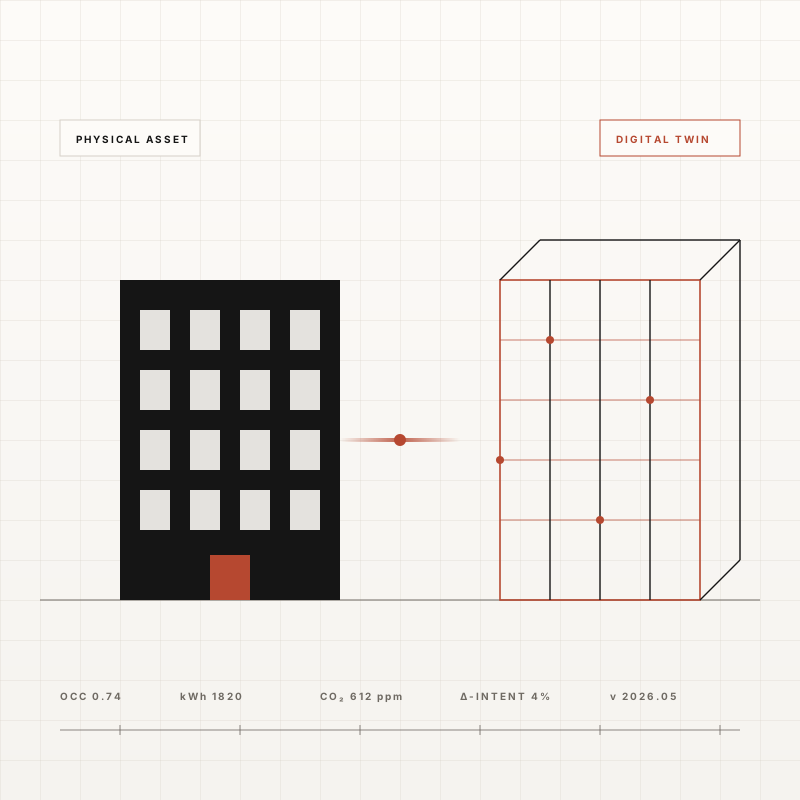
For decades the building has been the deliverable. The drawings, the model, the renderings — these were instruments to get to a built asset, then quietly retired. The digital twin reverses that order. The model becomes the long-lived artifact, and the building becomes one of its many states.
The useful starting point is not a technology label but the owner’s intended use. An accurate standalone model may support visualization, coordination, marketing, scenario studies, and long-term reference. When operations require it, that model can become a connected twin that incorporates sensor, occupancy, energy, or other live data. The scope should be sized to the decisions the model needs to support.
For designers, this is a category shift. The work product is no longer a static documentation set handed across a fence. It is a living dataset, one that other systems will consume long after the ribbon is cut. That changes everything from how we name layers to how we structure room programs to how we think about the relationship between schematic intent and post-occupancy reality.
From rendering to simulation
The first generation of architectural visualization sold the building. Marketing renders, fly-throughs, hero shots. The second generation — what we are entering now — sells the operating model. A prospective tenant does not just want to see what a floor will look like; they want to know how it performs under a Tuesday afternoon load with the HVAC running on shoulder-season setpoints. A capital partner wants to see ten-year energy curves under three climate scenarios before they sign. A facilities lead wants to know which assets are reaching the bottom of their service life next quarter.
A simulation-ready asset answers those questions on demand. It folds together the BIM model, the IoT layer, the operational schedule, and a thin orchestration layer that keeps everything in sync. Crucially, it treats those layers as independent: the geometry can be wrong without breaking the energy model, the sensors can drop without corrupting the room program. Loose coupling is the engineering principle that makes this whole thing tenable at the scale of a real portfolio.
A digital twin earns its keep when it lets you ask better questions, not when it produces prettier pictures.
What designers and engineers should actually build
The temptation, on hearing about digital twins, is to scale up: more sensors, more dashboards, more channels of telemetry. The teams getting useful results are doing the opposite. They are starting from a few well-defined operational questions — usually about energy, occupancy, or asset reliability — and pulling exactly the data needed to answer them. The model is sized to the question, not the other way around. This is a lesson product engineers learned painfully a decade ago and that AEC is now learning at a different scale.
The teams doing this well share a few habits:
- They treat the room program — not the geometry — as the primary key. Every space has a stable identifier that survives renovations, retenanting, and rework. Sensors and metadata bind to that identifier.
- They version their semantics. Tenant types, asset categories, and equipment taxonomies live in versioned dictionaries, not free text fields. The taxonomy is part of the model.
- They separate the live signal from the design intent. The twin records what the building was supposed to do alongside what it actually did. The delta is where insight lives.
- They publish a stable read-only API. Operators, tenants, and analysts consume the twin without writing back. Writes are governed.
- They avoid sealing the model inside a single proprietary platform. The cost of a closed twin compounds with every year you operate it.
Operational storytelling, not marketing rendering
For owner-side teams, the most underrated benefit of a real digital twin is narrative. A well-instrumented building tells a coherent story to investors, tenants, and operators about how it is being used, how it is performing against intent, and where it is heading. That story is not a quarterly PDF; it is a queryable surface that anyone with the right access can interrogate. This is operational storytelling, and it is much harder to fake than a hero render. Buildings that can tell a credible story about themselves command better terms.
The forward-looking question for design teams is what the schematic-phase deliverable looks like in this world. The answer is probably not a richer 3D model. It is a clearer specification of which questions the twin will need to answer over the lifetime of the asset, and which signals the project must collect from day one to support those questions. That is a programming problem before it is a modeling problem, and getting it right at the brief stage is worth more than any geometry refinement that comes later.
Where this goes next
The next horizon is the cross-asset twin: portfolios where each property reports against a shared schema and a shared performance vocabulary, so a fund can look across hundreds of buildings and ask one question consistently. That is a data engineering problem dressed up as a real estate problem, and the firms that solve it first will set the language the rest of the industry has to speak. Designers who understand that early will be drafting the terms of their own future briefs.
A digital twin is not a deliverable. It is a long bet that the building you are designing will be operated, measured, retrofitted, and reasoned about for forty years, and that the people doing that work deserve a model worth their time. Build it that way from the brief.