Furniture, fixtures, and equipment is where most built-environment projects quietly lose their budget. Not in a single dramatic scope blow-up — those at least get attention — but in the steady drift of hundreds of small decisions made under time pressure, by people who do not have a complete picture of what has already been committed. BudgetBuilder is an attempt to fix the picture.
The premise is simple. FF&E is governed badly because the governance instrument is almost always a spreadsheet, and a spreadsheet is the wrong shape for the problem. Spreadsheets reward a single editor and punish concurrent decisions; FF&E is a domain where designers, owners, GCs, and fabricators are all making partial commitments at the same time. By the time the spreadsheet catches up, the money is gone.
Where FF&E budgets actually fail
The popular narrative is that FF&E budgets fail because the design team specified things that were too expensive. That happens, but it is not the dominant failure mode. The real culprits, in order of frequency, are these:
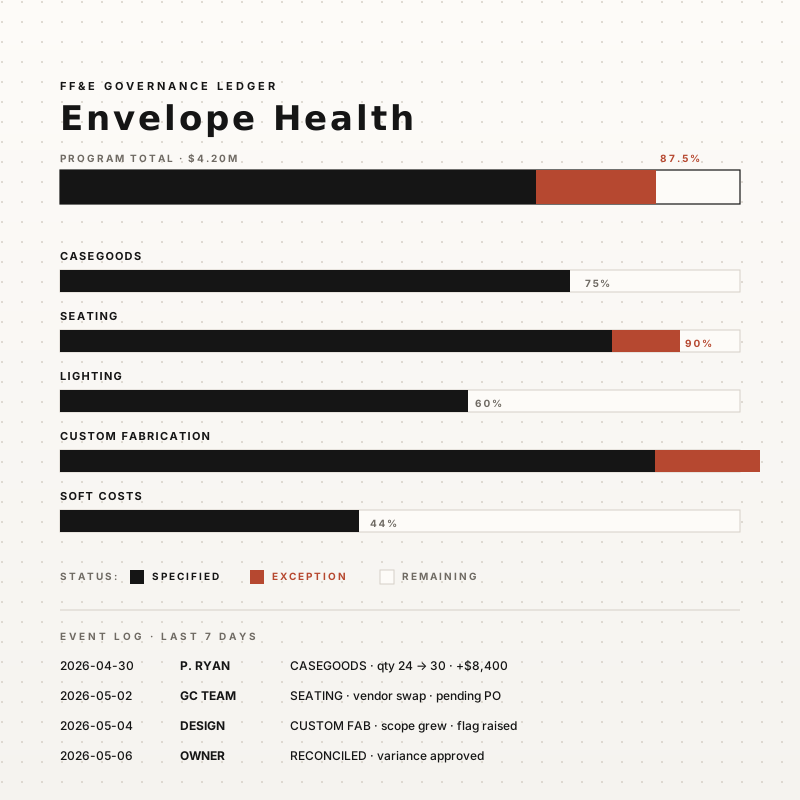
- Quantity drift. The design narrative assumes 24 dining chairs per zone; the construction documents reflect 30; nobody re-priced. Multiply across a project.
- Lead-time substitutions. A specified piece is unavailable on schedule, the GC swaps in a comparable item, the comparable item is in a different category and rolls up against a different bucket. The budget looks fine until reconciliation.
- Soft costs masquerading as hard costs. Freight, install, lift gates, white-glove handling, regional taxes, and storage between fabrication and install. These are 8–18% of true delivered cost and are routinely modeled at zero.
- Inflation and surcharges between specification and PO. A line specified at the SD package is rarely procured at the SD price.
- Custom-fabrication scope creep. The single most expensive change order in any FF&E budget is a custom piece that grew in the shop drawing review. Nobody sees it because it is one line item that doubled.
None of these are exotic problems. They are the bread and butter of a delivery-stage project. What makes them lethal is that they happen out of view of the people authorizing the budget, in tools that were never designed to surface them. A modern governance tool has to do exactly that surfacing, and it has to do it without becoming yet another platform that nobody has time to log into.
What governance actually means
For designers and engineers reading this, governance is not a synonym for control or for paperwork. The right way to think about FF&E governance is the same way a senior platform engineer thinks about deploys: a rate of change is fine, even desirable, as long as you can see it, attribute it, and roll it back. Translated to a built-environment project, that means three capabilities the budget instrument has to provide.
First, every line has to have an owner. Not a department, not a role — a name, on a date, with a decision. If a spec was changed, who changed it, when, and against which authorization. Second, every category has to have a ceiling and a current burn, both visible at all times to everyone making allocation decisions. Most overruns happen because the person making the call did not know the bucket was 92% spent. Third, the system has to support concurrent edits without lying about state. That is a database problem, and it is why spreadsheets fail at this.
A budget that can't tell you who spent the money, when, and against what authorization is not a budget. It is a record of regret.
How BudgetBuilder is shaped
BudgetBuilder, in its current beta, is a thin layer over those three capabilities. Each line item is an addressable object with an authorizing party, a category, a status, and a versioned history. Categories roll up into envelopes. Envelopes roll up into the program total. Status is not free-text; it is a small, governed enumeration — Specified, Approved, PO'd, Delivered, Installed, Reconciled — which lets the tool count what is committed versus what is merely intended. Soft costs are first-class line items, not a percentage applied at the end.
The product surface is deliberately quiet. There is no dashboard that demands daily attention, no notification stream, no chat. The tool is meant to be opened during decisions, not in between them. Most of its value lives in two surfaces: a quick glance at envelope health before any commitment, and an end-of-week reconciliation view that reads like a small newspaper of what changed and why. The second is what owner-side teams have been asking for, in our experience, more loudly than anything else.
Engineering notes for the curious
BudgetBuilder is built around an event log, not a snapshot. Each commitment, change, and reconciliation is an immutable event, and the current state of the budget is a reduction over those events. This is the same pattern that financial systems have used for a long time and that most project tools quietly avoid because it is harder to implement. The payoff is that you can ask the system, at any moment, what the budget looked like on a given Tuesday in March, and you can attribute every dollar of variance to a specific decision. That is the floor of real governance.
The tool deliberately does not try to be the procurement system, the design system, or the asset register. It integrates with all three but does not replace any of them. This is the second hard-won lesson of the last decade of construction software: any tool that tries to be the system of record for everything ends up being the system of record for nothing. BudgetBuilder is opinionated about being the budget instrument, full stop, and lets the rest of the stack do its job.
What this means for design practice
For designers, the cultural shift is the harder part. FF&E governance has historically been treated as a delivery-team chore, separate from the design vision. That separation is the source of most overruns. A specification that has been priced, owned, and tracked from day one is not less creative than a specification that has not — it is more durable, because it tends to survive the move from concept to install with its intent intact. Treating governance as a design surface, not a back-office function, is how you protect the work you actually want to make.
BudgetBuilder is in beta for a small number of projects this year. The interesting question is not whether the tool ships on time; it is whether the discipline it encodes spreads, with or without the tool. Either outcome is a win.