
A studio launch is, on the surface, a small thing — a name, a sign on a door, a website. Underneath it is an argument. This one is an argument that the built environment needs a different shape of practice: one that sits closer to the owner, earlier in the process, and stays in the work longer than most consultants are paid to.
The new platform is positioned around a single observation. Most projects in the built environment fail not at design and not at construction, but in the seam between them — the long, unloved middle where intent has to survive contact with budgets, vendors, fabricators, and reality. The studios that get hired to dream are usually different from the firms that get hired to deliver, and the asymmetry creates a translation tax that the owner pays every time. A practice that lives in that seam is rare, and that scarcity is the opportunity.
Why a new hub, and why Denver
Geography still matters in this industry, but for different reasons than people assume. Denver is not the cheapest city to operate in, nor the largest market for hospitality and retail design. What it offers is a particular density of project types — adaptive reuse, mid-market hospitality, mixed-use food and beverage, civic-scale wayfinding — at a scale where one team can stay close to the work without being ground down by the freight of a coastal megacity. The Front Range has become a sandbox for the kind of careful, buildable, durable design thinking that loses oxygen in markets driven by faster capital.
The hub is a creative space first and an office second. The room is set up to host owners, fabricators, and trade partners across the same table — a workflow choice as much as a real estate choice. Most of the meaningful decisions in a project happen when the people who design something and the people who build it are talking directly. A studio that makes that easy structurally tends to make better buildings. The space is sized for that pattern.
The website as a working tool
A studio website is usually a brochure. The new platform tries to be something else: a working tool. The case studies are built so that owners can read them sideways — not as marketing, but as a series of decisions and trade-offs that map to their own project. The portfolio timeline on the homepage stretches from 1990 to 2028 and is designed to show range and rhythm rather than recency, because most owners are not asking what is new, they are asking what has held up. The taxonomy of services is plain language. The contact path is short.
For engineers, the build itself is a small object lesson in restraint. React, Vite, Tailwind, and a deliberate choice not to add a CMS until the surface area justifies one. Content lives in versioned source files, which means every copy edit is reviewable, attributable, and rolled back like any other change. That is not the right answer for every site, but for a portfolio practice, the cost-of-ownership math favors source-controlled content over a database for a long time. The site is a quiet argument that you should resist the platform you do not yet need.
Most projects in the built environment fail in the seam between design and delivery — the long, unloved middle where intent meets reality.
What the practice is for
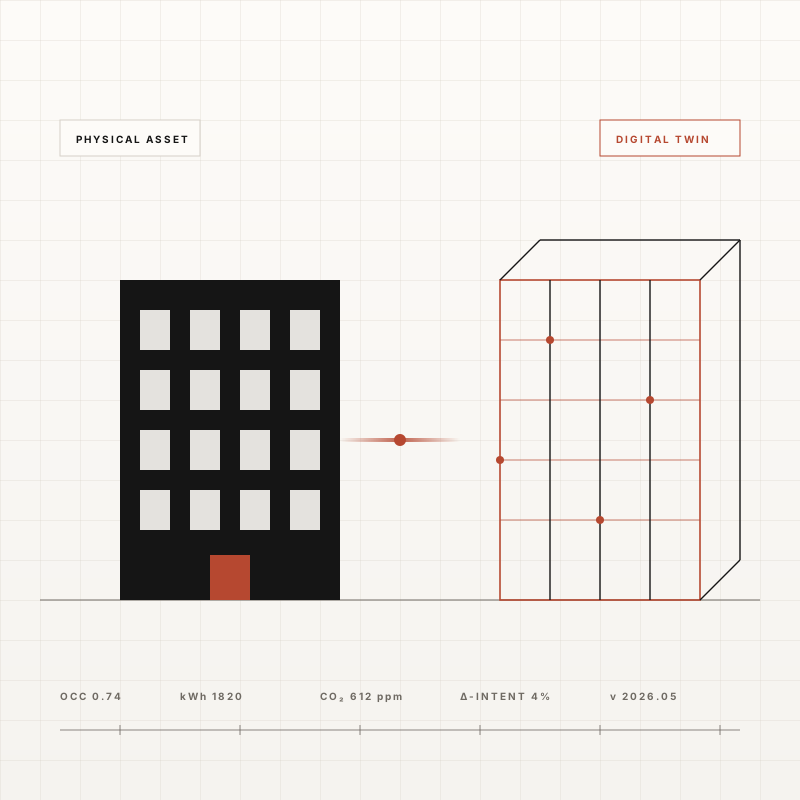
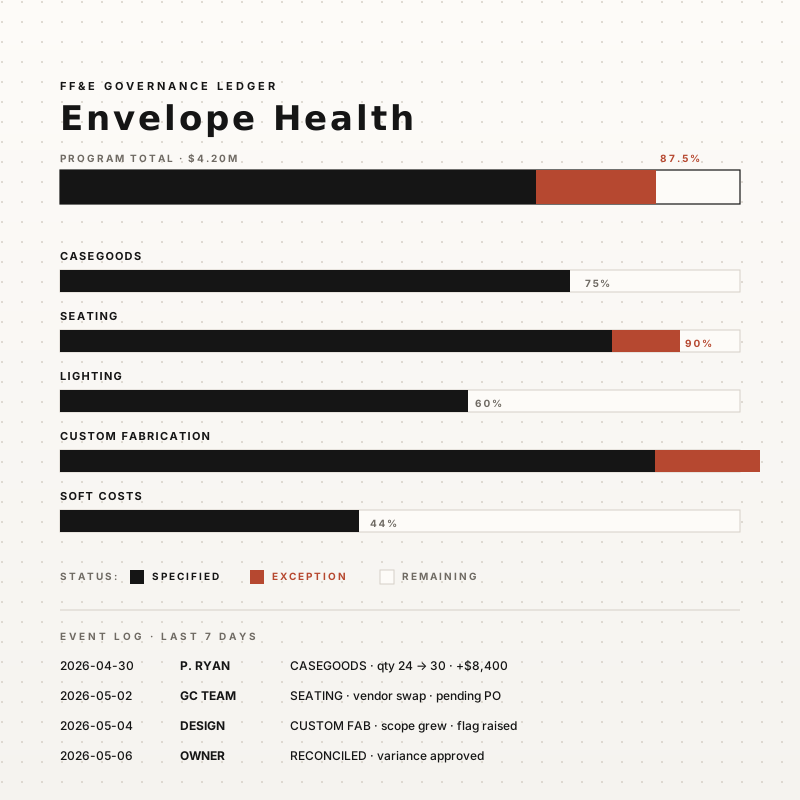
The practice begins with owner-side design advocacy: translating business goals into an owner-approved design program, concept framework, and decision set. That direction can then continue through turnkey FF&E procurement, CAD and visualization, industrial product development, graphic design and interior identity, digital twins, and managed custom fabrication. Each service can stand alone, but the greatest value comes from giving the physical and visual parts of a project one coherent point of view.
The working theory is that owners need design decisions they can understand, approve, and use. Sites & Space focuses on that design intent and on the design, procurement, documentation, and production scopes it is engaged to provide. Construction contracts, contractor budgets, pay applications, change orders, and the overall construction schedule remain with the owner and the appropriate project professionals.
A note on tools and forward-looking practice
The launch coincides with a deliberate investment in tooling. Visualization workflows now run through a hybrid stack of Unreal-quality real-time rendering, AI-augmented concept iteration, and traditional construction documentation. None of that is novel on its own; what is novel, increasingly, is how willing a studio is to combine those tools without dogma. The next ten years of design practice will reward firms that are fluent across mediums and disciplined about which medium fits which decision. Spending three days on a hand sketch and two minutes on a generative pass — and knowing which one belongs at which gate — is going to be a real skill.
For designers reading this who are weighing a studio of their own, the unglamorous lesson is that a practice is a software product. It has users (owners, contractors, fabricators), a release cadence (projects), a backlog (work in flight), and a maintenance burden (the long tail of every job you have ever finished). Designing it deliberately, with the same care you would give a building, is the difference between a studio that wears you down and one that compounds. The new hub is built to compound.
Visitors are welcome by appointment. Project inquiries route through the contact form, which lands in a real inbox monitored by a real person — another small, deliberate choice in a category that has drifted toward chatbots. The work is the work; the platform is the way back to it.